Call us: +91 8080680805
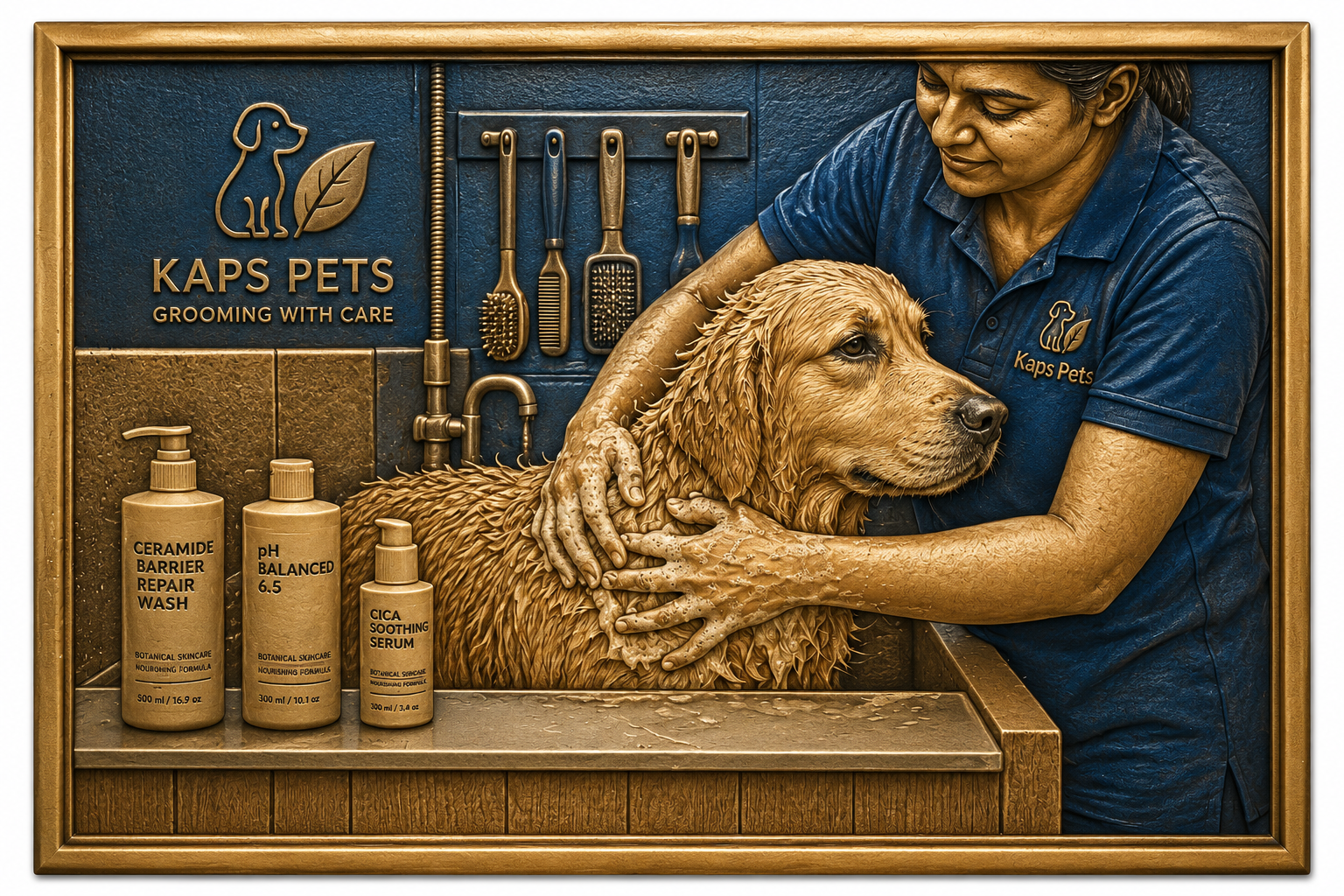

1. Introduction: Beyond the “Bath and Brush”
For decades, dog grooming was treated as a cosmetic chore. You dropped your pet at a salon, they were scrubbed with generic soap, dried quickly, and sent home smelling like artificial lavender. But in 2026, the global pet industry has reached a tipping point. We are now in the era of Skinification.
This term, borrowed from human high-end skincare, describes a move away from “one-size-fits-all” shampoos toward targeted, ingredient-led routines. As an expert who has spent years in the workshop designing equipment for active dogs and operating retail pet chains in Navi Mumbai and Goa, I have seen the damage that traditional grooming can do. In this guide, we will explore why treating your dog’s skin like an organ—rather than just a surface—is the key to a longer, healthier life.
2. The Science: Understanding the Canine Skin Barrier
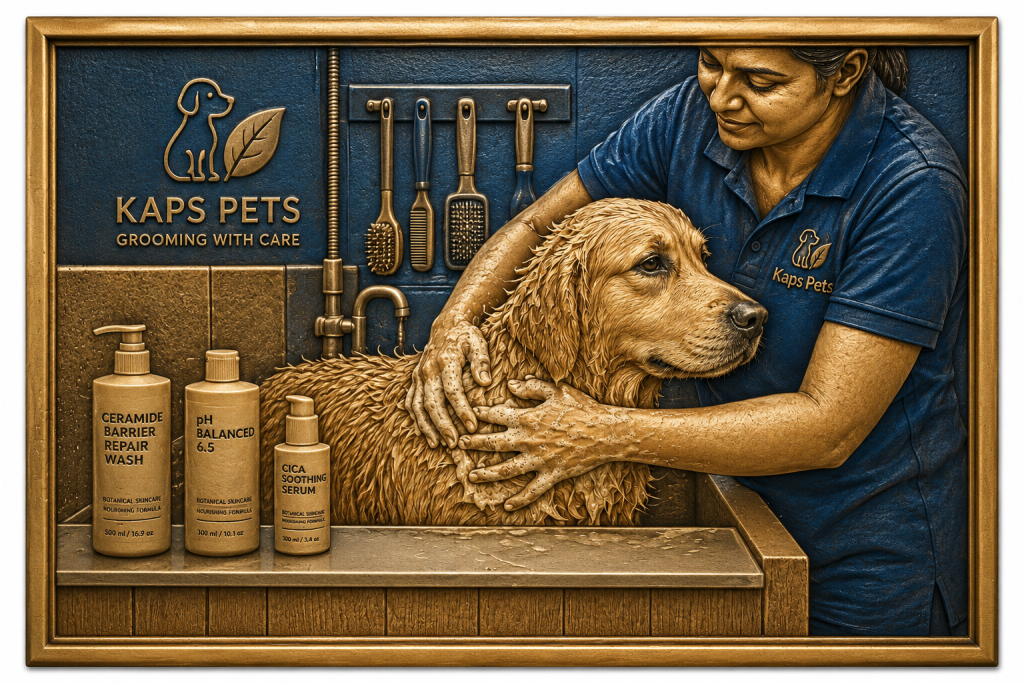
To appreciate skinification, we must understand the biological differences between us and our dogs. Human skin is naturally acidic, sitting at approximately $5.5$ on the $pH$ scale. In contrast, dog skin is much more neutral to alkaline, ranging between $6.2$ and $7.5$.
The Acid Mantle Crisis
When you use a generic “mild” shampoo that isn’t specifically $pH$-balanced for dogs, you strip away the Acid Mantle. This is a thin, protective film that acts as the dog’s first line of defense against:
Transepidermal Water Loss (TEWL): When the barrier breaks, moisture escapes, leading to the flaky, dry skin common in Indian summers.
Pathogenic Invasion: An alkaline environment is a playground for Staphylococcus bacteria and Malassezia yeast.
The “Doggy Smell”: Contrary to popular belief, that smell isn’t just “dog.” It is often the byproduct of an overgrowth of yeast caused by a compromised skin barrier.
3. The 2026 Ingredient Revolution: What to Look For
In 2026, savvy pet owners are reading labels like chemists. If your groomer isn’t talking about “active botanicals,” it’s time to upgrade.
Centella Asiatica (Cica)
Often called “Tiger Grass,” Cica has become the hero ingredient of the 2026 pet wellness boom. It is incredibly effective at healing micro-tears in the skin caused by scratching and environmental friction. For active dogs using agility equipment, Cica-infused paw balms are a necessity.
Ceramides and Hyaluronic Acid
Just as these ingredients plump human skin, they serve to “mortar” the skin cells of a dog together. We recommend “leave-in conditioners” that contain these lipids to maintain hydration between professional grooming sessions.
The Problem with “Fragrance”
In the past, a “clean” dog was a “scented” dog. However, artificial fragrances are the leading cause of contact dermatitis in pets. In 2026, we prioritize Functional Aromatherapy—using therapeutic-grade essential oils like Lavender or Cedarwood that provide a scent while actually calming the skin and the pet’s nervous system.
4. The Regional Context: Grooming in India (Navi Mumbai to Goa)
Climate plays a massive role in skin health.
High Humidity (Goa/Mumbai): Creates a breeding ground for fungal infections. We advocate for “De-shedding” protocols that allow the skin to breathe.
Urban Pollution: Particulate matter from city air can settle deep into a dog’s coat. A 2026 grooming routine must include a “Pre-Wash Detox” using charcoal-based cleansers to pull out heavy metals and pollutants.
5. The “Maker’s” Perspective: Grooming for Performance
As a manufacturer of dog park and agility equipment, I view grooming through the lens of safety and performance.
Nail Health: Long nails don’t just scratch floors; they alter a dog’s biomechanics. On an A-frame or a see-saw, a dog with long nails cannot grip properly, leading to joint strain.
Paw Pad Integrity: A dry, cracked paw pad is a liability. We advocate for “Traction Grooming,” where the hair between the pads is trimmed flush to prevent slipping on agility surfaces.
6. The Rise of “Fear-Free” and “Low-Stress” Environments
2026 is also about the emotional skin of the dog. Traditional high-velocity dryers can be terrifying. The new standard involves:
Acoustic Management: Using “Happy Hoodies” to muffle noise.
Pheromone Diffusers: Creating a calming atmosphere in the grooming bay.
Positive Reinforcement: High-value treats throughout the process to build a “Grooming-Positive” association.
7. Sustainability: Plastic-Free is the Default
By 2026, the trend has moved heavily toward Solid Shampoo Bars. These eliminate the need for plastic bottles and are often more concentrated, meaning fewer preservatives are required. If you are a pet parent in 2026, your first question to a brand should be: “What is your plastic footprint?”
8. Conclusion: Your Dog’s Skin is a Reflection of Their Health
Skinification isn’t a fad; it’s a standard. By focusing on $pH$ balance, barrier repair, and functional botanicals, you aren’t just making your dog look good—you are extending their life and comfort. Whether your dog is a champion on the agility course or a “couch potato” at home, their skin deserves the same level of care you give your own.
FAQ Section (Optimized for Google Snippets)
Q: How often should I bathe my dog in 2026?
A: With the new barrier-repair shampoos, you can bathe every 2 weeks, provided the products are $pH$-balanced.
Q: What is the best ingredient for itchy dog skin?
A: Look for Centella Asiatica (Cica) and Colloidal Oatmeal to soothe inflammation immediately.
Q: Why does my dog smell again 2 days after a bath?
A: This is likely a sign of a “Yeast Bloom” caused by an alkaline skin $pH$. Switching to a $pH$-balanced, antifungal botanical wash can fix this.